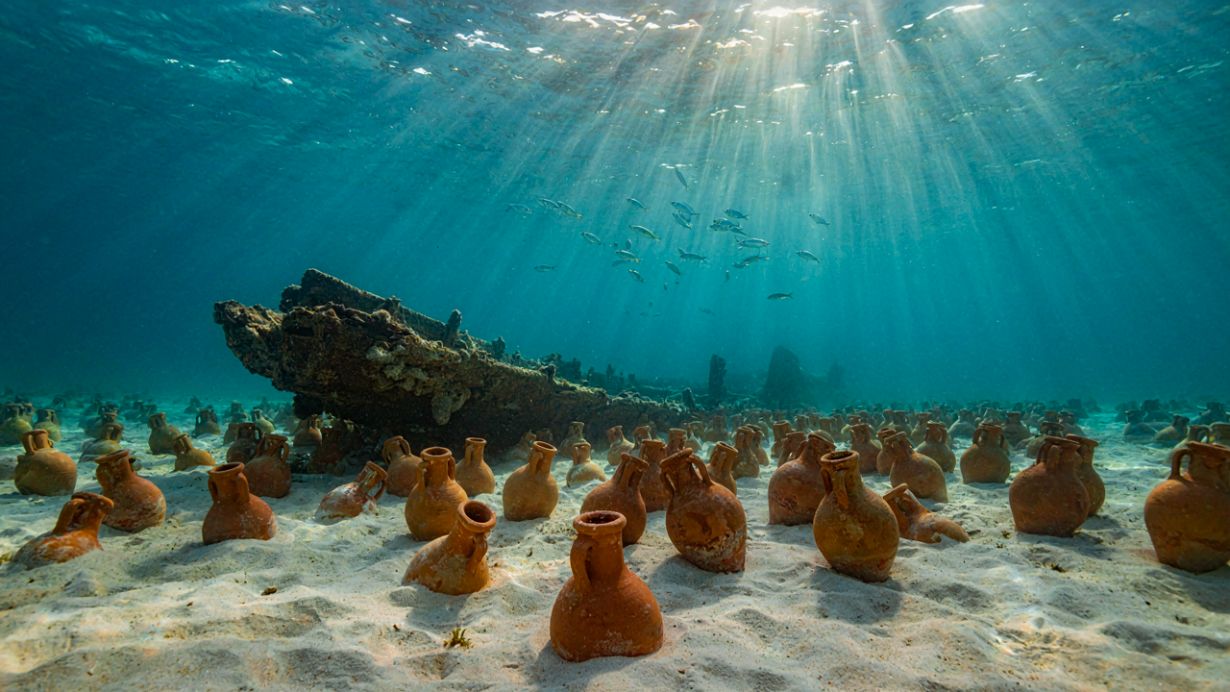
A stunning Roman shipwreck discovery off the coast of Italy is officially going viral this month, captivating history buffs and ocean explorers across the internet. Hiding in the Mediterranean Sea for over two millennia, this ancient vessel has just been revealed as a perfectly preserved time capsule.
Found just three miles off the coast of Mazara del Vallo in Sicily, the 2,100-year-old ship was located at a depth of 46 meters. The stunning footage, captured by underwater cameras, shows a scene straight out of an adventure movie.
Inside the 2,100-Year-Old Roman Shipwreck Discovery
What makes this Roman shipwreck discovery so incredible is the sheer volume of perfectly intact artifacts. Divers Giacomo De Mola and Igor Bisulli, who investigated the site following a tip-off from local fishers, were greeted by a vast expanse of ancient cargo.
The sunken ship, measuring roughly 21 meters long, was carrying about 500 amphorae. These ancient two-handled ceramic jars, specifically identified as Dressel 1A amphorae, were primarily used for transporting wine. De Mola shared his awe online, calling it “without a doubt, the most incredible discovery of my life”.
Why This Roman Shipwreck Discovery Matters Today
Beyond the stunning visuals that are taking over social media, this Roman shipwreck discovery is a major scientific breakthrough. It gives archaeologists a direct look into the ancient commercial networks that connected Italy to the rest of the Mediterranean world centuries ago.
- The cargo provides precious evidence of 2,100-year-old trade routes.
- Researchers are now working to determine the exact origin and intended destination of the massive ancient wine shipment.
- Officials are rapidly drawing up measures to protect this highly significant site from looters and environmental damage.
Our Take
It is absolutely amazing that our oceans are still hiding so much of human history. The viral Roman shipwreck discovery is a beautiful reminder that there is still an entire world left to explore beneath the surface. We cannot wait to see what researchers learn once they fully analyze these ancient jars!


