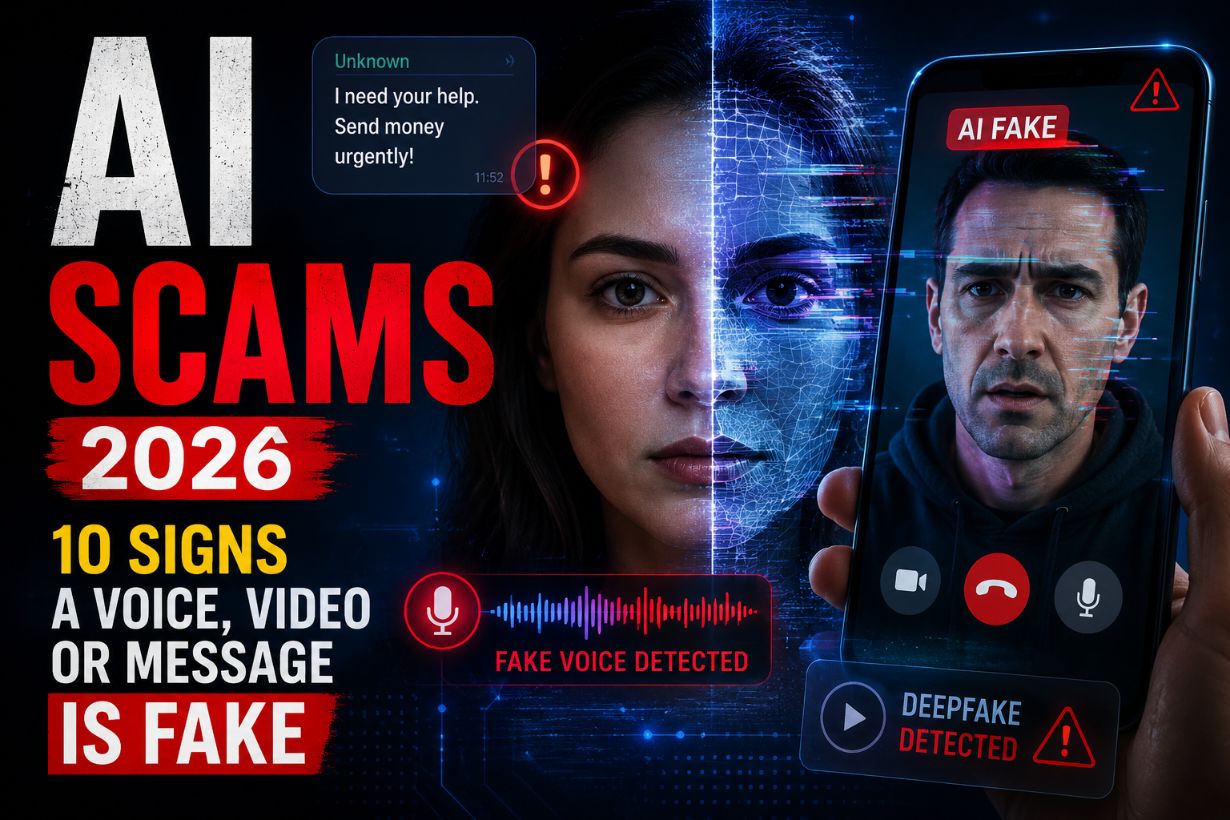
What if the person calling you isn’t actually the person you think it is? A voice that sounds exactly like your boss. A video call that appears to show a family member. A message written perfectly in the language you normally use.
In 2026, scammers don’t always need terrible spelling, suspicious-looking websites or obviously fake messages anymore.
Artificial intelligence is making online scams faster, more personalized and much harder to recognize at first glance.
And that creates a new problem: sometimes your eyes and ears are no longer enough to verify what you’re seeing.

🚨 The New Rule of Online Safety
Don’t trust something simply because it looks or sounds real.
A familiar voice, a professional-looking message, a video call or a convincing company logo can all be copied or manipulated.
When money, passwords, verification codes or sensitive information are involved, verify the request through a separate channel.
- Someone suddenly asks for money? Pause and independently verify them.
- A boss asks for an urgent payment? Call them using a number you already have.
- A family member sounds distressed? Ask a question only the real person would know.
- A video call looks strange? Don’t assume the video proves identity.
- A message contains a login link? Open the official app or website yourself.
- Someone asks for an OTP or security code? Never give it to them.
AI Scams Have Entered a New Era
For years, one of the easiest ways to spot a scam was poor grammar.
That trick is becoming less useful.
Generative AI can help criminals produce polished messages, translate them into different languages and personalize them for specific victims.
That means a scam message can look professional while still being completely fraudulent.
The bigger shift is that AI can also be used to imitate voices, create manipulated images and produce convincing video content.
The result is a new type of social engineering: instead of simply pretending to be someone, scammers can increasingly imitate how that person communicates.

1. The “Boss” Scam: “I Need You to Pay This Right Now”
Imagine receiving a message from your manager.
The message says there is an urgent payment that needs to be completed immediately.
The writing sounds exactly like them.
Maybe the profile photo is correct too.
Then your phone rings.
You hear your boss’s voice asking you to complete the payment.
This is exactly the kind of situation where you should stop and verify independently.
2. The Family Emergency Scam
This one can be even more emotionally powerful.
You receive a call from someone who sounds like your son, daughter, brother, sister or another relative.
They claim they are in trouble.
They need money.
They tell you not to call anyone else.
They may even know personal information that makes the story feel authentic.
Don’t let fear make the decision for you.
Hang up and contact the family member using a phone number you already have saved.
If you cannot reach them, contact another trusted relative.
3. Fake Video Calls: Don’t Assume Video Means Real
Video has traditionally felt more trustworthy than a text message.
After all, if you can see someone’s face, surely you know who you’re talking to.
Not necessarily.
AI-generated and manipulated video technology is making it increasingly important to verify identity independently when something important is being requested.
A strange face movement, unusual lighting or poor lip synchronization can sometimes be a warning sign.
But don’t rely on visual glitches alone.
High-quality manipulation may not be obvious.

4. The “CEO Voice” Scam
Businesses are particularly vulnerable to impersonation scams.
A criminal may target an employee who has access to payments, customer information or company accounts.
The scammer then creates a situation that appears to come from an executive.
The request might be:
- “Send this payment immediately.”
- “Buy gift cards for the team.”
- “Transfer money to this new account.”
- “Don’t discuss this with anyone yet.”
- “I’m travelling and can’t access my normal account.”
These requests should trigger a verification procedure, not obedience.
5. The Fake Bank Alert
A message appears on your phone:
“Suspicious activity detected. Your account will be frozen unless you verify now.”
You panic.
You click the link.
The website looks like your bank.
It asks for your username, password and one-time verification code.
That’s the trap.
🏦 Your Bank Should Never Be “Verified” Through a Random Link
If a message claims there is an emergency with your bank account, open the official banking application yourself or type the bank’s official website address manually.
Never rely on the link inside the suspicious message.
6. The Fake Delivery Scam
This is one of the easiest scams to personalize.
You receive a message saying:
“Your package could not be delivered. Pay a small fee to reschedule.”
The message may include your name, an expected delivery date or a company logo.
That does not make it genuine.
If you are expecting a package, check the order through the retailer or courier’s official website or application.
7. The Fake Job Offer
Job seekers are another attractive target.
A scammer may contact you with an impressive job opportunity and then request:
8. The Romance or Friendship Scam
AI makes it easier for scammers to maintain conversations over long periods.
A fake profile may use stolen photographs, convincing messages and carefully constructed stories.
The relationship gradually becomes emotional.
Then a financial emergency appears.
Travel.
Medical expenses.
A business opportunity.
An investment.
Whatever the story is, the principle remains the same: never send money simply because someone online has built an emotional connection with you.
🌍 Why This Matters Across Africa
AI-assisted scams are not limited to Silicon Valley or major Western markets.
People across Africa increasingly rely on smartphones, mobile banking, digital payments, social platforms and messaging applications.
That creates enormous convenience — but also creates more opportunities for criminals to exploit trust.
In markets including Mauritius, Nigeria, Kenya, Ghana, South Africa, Uganda, Tanzania and other digitally connected economies, consumers should be especially cautious about requests involving mobile money, banking, employment, deliveries and identity verification.
The same warning applies globally to people in India, Pakistan, the United Kingdom, Europe, the United States and beyond.
9. Seven Red Flags That Should Make You Stop Immediately
10. The Most Important AI Scam Rule: Verify Through Another Channel
This is the single most useful habit you can develop.
If someone sends you a message asking for money, don’t verify them using the same message.
If someone calls you asking for money, don’t verify them using the same phone number.
If your boss sends an urgent payment request, call your boss using their normal number.
If your bank sends a warning, open your banking app yourself.
If a relative calls with an emergency, call them back using your saved contact.
What Should You Do If You Already Sent Money?
Don’t wait because you’re embarrassed.
The sooner you report a suspected fraudulent transaction, the better.
Contact your bank, card provider or payment service using an official contact method.
Explain exactly what happened.
Keep screenshots, transaction references, phone numbers, emails and other relevant evidence.
If appropriate in your country, report the incident to the relevant police or cybercrime authority.
Do not send additional money to someone claiming they can recover your lost money.
Recovery scams can target victims a second time.
What If You Gave Away Your Password?
Act immediately.
- Change the exposed password.
- Change the same password anywhere else you reused it.
- Enable multi-factor authentication.
- Review recent account activity.
- Check recovery email addresses and phone numbers.
- Sign out unknown devices or sessions.
- Watch for unexpected password-reset messages.

Don’t Rely on These Old Scam-Detection Tricks
Some traditional advice is still useful.
But several popular assumptions are becoming less reliable.
❌ “Scammers Always Make Grammar Mistakes”
Not anymore. AI can produce polished text.
❌ “The Profile Photo Looks Real”
A profile photograph does not prove identity.
❌ “I Heard Their Voice”
A familiar voice should not be treated as sufficient proof when money or sensitive information is involved.
❌ “I Saw Them on Video”
Video can be manipulated. Use independent verification for high-risk requests.
❌ “They Know My Name and Personal Details”
Personal information can come from social media, data leaks, public records and other sources.
The 30-Second AI Scam Test
Why AI Scams Could Become Even More Convincing
The technology is improving rapidly.
AI systems can already generate convincing text, images, audio and video.
That means the traditional idea of “spot the obvious fake” may become increasingly difficult.
The strongest defense therefore isn’t becoming an expert in detecting every AI-generated image or voice.
It’s building a habit of independent verification.
🧠 The New Digital-Safety Mindset
Don’t ask only: “Does this look real?”
Ask: “Can I independently prove that this person, message or request is genuine?”
What Parents Should Teach Children About AI Scams
Children and teenagers are spending more time online, which means families should talk about digital trust early.
Teach them that:
- They should never share passwords.
- They should never share verification codes.
- They should tell a trusted adult if someone asks for money.
- They should not send private photographs to strangers.
- They should be careful with strangers contacting them through games and social media.
- They should never feel pressured to keep an online conversation secret.
What Businesses Should Do Differently
Companies should not rely entirely on employees recognizing suspicious messages.
High-risk financial actions should have independent verification procedures.
For example:
- Require a second approval for unusual payments.
- Use established payment procedures.
- Verify changes to bank account details independently.
- Train staff about AI impersonation.
- Never rely solely on voice recognition for financial approval.
- Encourage employees to challenge unusual requests without fear of punishment.
🔥 ViralDada Question
Would you recognize a scam if the person calling you sounded exactly like someone you know?
Have you ever received a suspicious bank message, fake delivery notification, strange job offer or unexpected social-media request?
Share your experience in the comments — but never post passwords, OTPs, bank details or other private information.
The Bottom Line: Your Eyes and Ears Are No Longer Enough
AI is changing almost everything about the internet — including the way criminals try to manipulate people.
The next scam you encounter may not look obviously fake.
It may be beautifully written.
It may use a familiar logo.
It may show a familiar face.
It may even sound like someone you trust.
That’s why the most important protection is not a special AI detector.
It’s a habit: slow down, stop the pressure and verify independently.
🛡️ ViralDada Take
The most dangerous scam isn’t necessarily the one that looks fake. It’s the one that looks real enough to make you stop thinking.
If money, passwords, OTPs, personal documents or account access are involved, never let urgency make the decision for you.
Hang up.
Close the message.
Open the official app.
Call the real person.
Verify independently.
Because in the age of AI, seeing isn’t always believing.
AI Scams & Deepfakes — Frequently Asked Questions
Can AI really copy someone’s voice?
AI technology can generate or imitate voices from audio samples. That is why a familiar voice should not be treated as sufficient proof of identity when money or sensitive information is involved.
Can scammers use AI to write phishing emails?
Yes. Generative AI can help create polished messages and adapt language, making grammar alone a less reliable way to identify scams.
How can I tell if a video call is fake?
Do not rely only on visual clues. For high-risk requests, independently contact the person through a trusted communication channel.
What should I do if someone claiming to be my family member asks for money?
End the conversation and contact the real person using a phone number you already know. You can also contact another trusted family member to verify the story.
Should I give someone my OTP if they say they are from my bank?
No. Never share one-time passwords or authentication codes with someone who contacts you unexpectedly.
Are AI scams only targeting rich countries?
No. Online fraud is global. Anyone using email, social media, messaging apps, mobile banking or digital payments can potentially become a target.
What is the best protection against AI scams?
Use strong unique passwords, multi-factor authentication, updated devices and — most importantly — independent verification whenever a communication involves money, account access or sensitive information.
What if I already sent money to a scammer?
Contact your bank, card provider or payment service immediately using an official contact method. Keep evidence of the transaction and report the incident to the appropriate authorities where applicable.


0 Comments
Join the conversation.