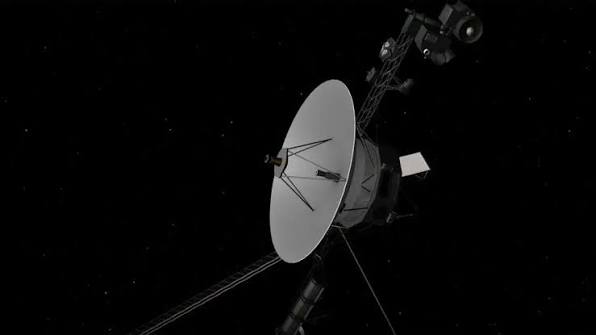
Deep in the cold vacuum of interstellar space, one of humanity’s most ambitious emissaries has just received a remarkable second wind. NASA engineers managing the historic Voyager 2 mission have successfully pulled off a power-saving maneuver known internally as the “Big Bang” reconfiguration. By systematically shifting several powered systems to lower-energy alternatives at the same time, the mission team managed to free up nearly 10 watts of precious electrical power.
This ingenious operational update is more than just a technical victory. It has successfully bought the spacecraft’s three remaining active science instruments at least another year of operational life. As Voyager 2 continues its unprecedented journey far beyond the boundaries of our solar system, every single milliwatt counts toward keeping humanity’s farthest artificial outpost talking to Earth.
The Power Challenge of an Aging Interstellar Explorer
Launched back in 1977, Voyager 2 and its twin, Voyager 1, were originally designed to study the outer gas giants. Decades later, both probes have long surpassed their primary planetary objectives, marching onward into the unexplored territory of interstellar space. However, operating for nearly half a century in the harsh conditions of deep space comes with severe logistical hurdles.
The primary power source for both Voyager spacecraft is a radioisotope thermoelectric generator (RTG). These generators produce electricity by converting the heat generated from the natural radioactive decay of plutonium-238 into electrical power. Because that radioactive material steadily decays over time, the total power output of the RTGs drops by roughly four watts every single year.
To make matters worse, the intense cold of deep space has caused components to degrade, forcing engineers to make difficult choices. Over the years, teams have had to switch off heaters and non-essential systems one by one just to keep the primary flight computer and the most vital science payloads functioning.
Inside the ‘Big Bang’ Reconfiguration Strategy
When resources dwindle to critical levels, traditional conservation methods are no longer enough. The recent strategy deployed by NASA in early 2026 earned its dramatic moniker because it required a simultaneous, coordinated shift rather than incremental adjustments. By altering the operational states of multiple secondary systems concurrently, engineers avoided cascading failures while maximizing overall energy retention.
This simultaneous shift successfully preserved nearly 10 watts of power. While 10 watts might sound trivial in our everyday lives—barely enough to power a very small household LED bulb—it represents a massive windfall for a spacecraft operating billions of miles away on a strictly managed power budget.
What This Means for Voyager 2’s Science Instruments
The newfound electrical current directly supports the continued operation of Voyager 2’s three remaining active science instruments. These instruments provide researchers on Earth with invaluable data regarding interstellar plasma, magnetic fields, and cosmic rays beyond the heliosphere.
Without this clever engineering intervention, mission planners would have faced the difficult reality of powering down one of those remaining instruments much sooner than anticipated. Thanks to the “Big Bang” maneuver, those instruments are guaranteed at least another year of continuous data collection.
Looking Ahead at the End of the Solar System
The Voyager mission remains a testament to exceptional mid-20th-century engineering. Communication signals now take more than 20 hours to travel one way between Earth and Voyager 2, meaning every command sent by the Jet Propulsion Laboratory requires immense patience and meticulous calculation.
As Voyager 2 pushes deeper into the unknown, milestones like this power reconfiguration highlight the incredible dedication of the teams working behind the scenes. While the clock is ultimately ticking against the natural decay of the spacecraft’s nuclear power sources, this latest victory proves that humanity’s farthest explorers are not ready to go quiet just yet.
Sources & Further Reading



0 Comments
Join the conversation.