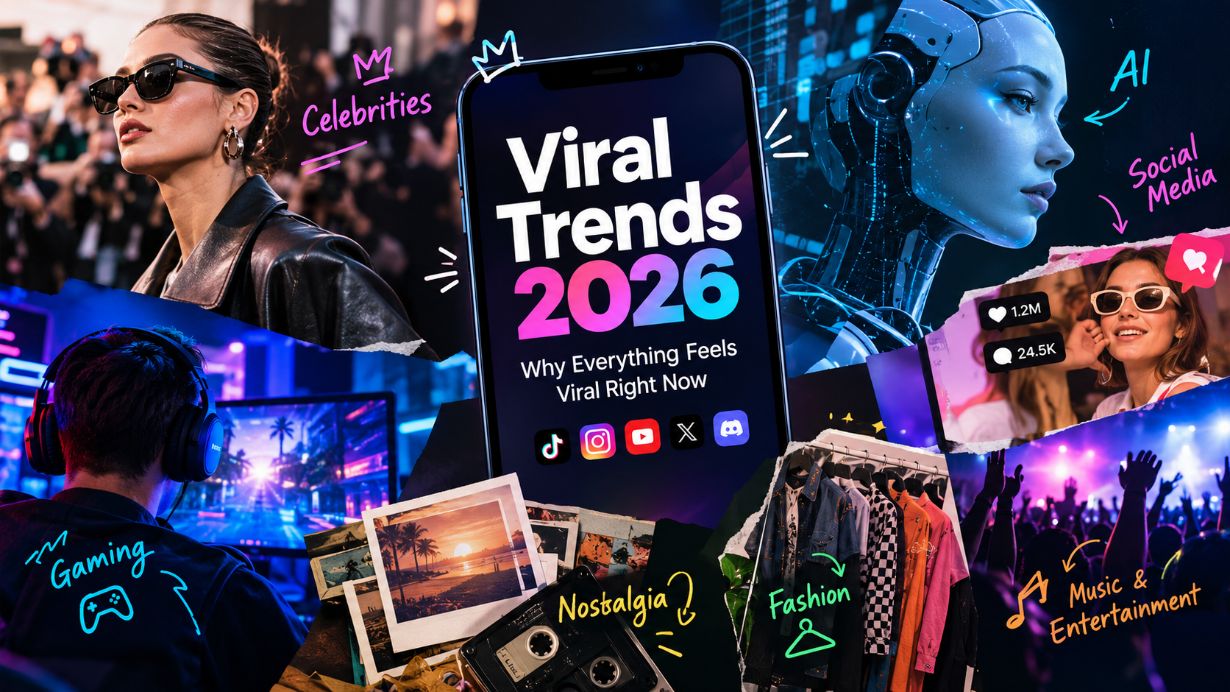
Viral trends in 2026 are no longer just about one funny video, one celebrity moment or one song that suddenly takes over everyone’s feed. The internet has become a constantly moving cultural machine where artificial intelligence, entertainment, gaming, fashion, nostalgia and celebrity culture can collide within a matter of hours.
The strange thing about – Viral Trends 2026 is that “viral” no longer feels like an event. It feels like the atmosphere.
Open your phone in the morning and there is a celebrity clip. At lunch, an AI video is making people argue about whether it is real. By evening, a gaming announcement has taken over social media. Then, almost out of nowhere, something from 2016 comes back and everyone suddenly remembers where they were ten years ago.

That is what makes viral trends in 2026 so interesting. The biggest stories are increasingly difficult to place inside one neat category. A technology story can become an entertainment story. A celebrity appearance can become a fashion story. A game trailer can become a meme before people have even finished watching it. A nostalgic reference can suddenly become the soundtrack for millions of short videos.
The result is a very different internet from the one many people remember from the early days of Facebook, Instagram, YouTube and Twitter. Back then, something went viral and people talked about it. Today, something can go viral, be remixed, parodied, criticized, explained, turned into a reaction video, transformed by AI and then disappear before the original creator has had time to understand what happened.
And yet there is something strangely human underneath all of this.
People still want to laugh. They still want to be surprised. They still want to discover something before everyone else. They still love celebrities, stories, games, music and movies. They still get nostalgic about the things they grew up with. Technology may have changed the speed of the conversation, but it has not changed the reasons people join it.
The internet is becoming one giant crossover episode – Viral Trends
One of the biggest changes behind viral trends in 2026 is the disappearance of hard boundaries between entertainment categories.
There was a time when a movie fan could mostly stay inside movie news, a gamer could stay inside gaming communities, and a fashion follower could follow designers without knowing what was happening in television or technology.
That separation barely exists anymore.
The same person might watch a celebrity interview on TikTok, see a gaming announcement on YouTube, encounter an AI-generated parody on Instagram, hear a nostalgic song on Spotify and then read a completely unrelated news story five minutes later.
The platforms are not organized around traditional media categories. They are organized around attention.
If something is interesting enough, it crosses the border.
This is why a celebrity moment can suddenly become a meme among people who do not even follow the celebrity. It is why a gaming trailer can become a cultural conversation among people who have never played the game. And it is why an AI demonstration can become entertainment rather than technology news.
The internet has become less like a collection of separate rooms and more like one enormous building where everyone keeps opening doors.
AI is changing what people believe they are watching – Viral Trends
Few forces are influencing internet culture more dramatically than artificial intelligence.
But the interesting part is not simply that AI can now generate images, video, voices or written material. The more important shift is psychological.
People are becoming less certain about what they are looking at.
A video can look real for the first few seconds and then reveal a strange hand, impossible reflection or background detail. A voice can sound almost exactly like someone you recognize. A fictional scene can be produced with enough realism to make viewers pause before deciding whether it actually happened.
That uncertainty itself can become viral.
AI-generated media has also created an entirely new type of internet conversation: people are not only reacting to the content, but trying to determine whether the content is authentic in the first place.
That distinction matters.
AI can produce something visually impressive without necessarily producing something emotionally convincing.
Humans are remarkably good at noticing small inconsistencies. We may not consciously identify every problem, but we can often feel that something is slightly wrong. A crowd may move unnaturally. A person’s expression may not match their voice. A street may look authentic while behaving like a dream.
And ironically, those imperfections can make the content even more shareable.
People send strange AI videos to friends because they want someone else to look at them and say, “Wait… is this real?”
That question is viral fuel.
The AI paradox
There is a fascinating contradiction developing around AI content.
People want AI to become more realistic, but once it becomes extremely realistic, they become more interested in proving that it is fake.
The technology therefore creates two kinds of entertainment at the same time: the creation itself and the investigation surrounding it.
“Look what AI made” is one story.
“Look what is wrong with this AI video” is another.
Both can go viral.
Celebrity culture is not disappearing — it is becoming more immediate
Every few years, someone predicts that celebrity culture is finished.
It never really is.
What changes is the way celebrities become visible.
In 2026, celebrity culture is increasingly built around moments rather than carefully controlled appearances. A red-carpet outfit, an unexpected interaction, a funny reaction, a short interview answer or a surprise appearance can become more important online than an entire promotional campaign.
The important thing is not simply that famous people are appearing at events.
It is that audiences increasingly experience those events through thousands of tiny fragments.

Someone may never watch an entire awards ceremony but still know the moment that became a meme. Someone may never read a fashion magazine but recognize a celebrity’s outfit because it appeared repeatedly across their feed.
Celebrity culture has effectively become modular.
You do not need to consume the whole event.
You only need the moment.
The “one moment” economy
This is one of the most important ideas for understanding viral trends in 2026.
A single moment can now carry an enormous amount of cultural weight.
Think about the number of times a person has become famous online because of one expression, one sentence, one dance, one outfit or one unexpected reaction.
The internet does not always reward the biggest production.
Sometimes it rewards the most recognizable moment.
Gaming has become mainstream culture, not a side category
Gaming used to be discussed as a specialist hobby.
That description feels increasingly outdated.
Today, games influence music, movies, fashion, memes, streaming, YouTube, Twitch and even mainstream celebrity culture.
A major game release can become an entertainment event on the scale of a movie premiere. A trailer can generate reaction videos within minutes. A character can become a meme before players have even experienced the story.

This is partly because games are uniquely interactive.
A movie gives you a story.
A game gives you a story and then asks what you will do inside it.
That creates an enormous amount of material for online conversation.
People debate characters, endings, graphics, maps, glitches, theories, easter eggs and gameplay mechanics. They create clips showing funny accidents. They stream themselves playing. They build communities around tiny details.
A traditional entertainment story may have a beginning, middle and end.
A game can generate conversations for years.
Why gaming is perfect for virality
Gaming has another advantage: it naturally produces reactions.
Something unexpected happens and a player screams.
Someone discovers a hidden detail.
A ridiculous glitch appears.
A difficult boss is finally defeated.
A friend makes an unbelievable mistake.
All of those moments are ready-made social content.
Nostalgia is having another major moment – Viral Trends
If there is one emotional force that continues to perform incredibly well online, it is nostalgia.
And 2026 is particularly interesting because the people who grew up with the early social-media era are now old enough to look back at it with genuine nostalgia.
Ten years suddenly feels like a different lifetime.
The phones were different. The apps looked different. Music videos felt different. Celebrity culture felt slower. YouTube had a completely different personality. Instagram feeds were more chronological. Memes had different rhythms.
Even internet design itself has become nostalgic.

That is why throwback content works so well.
It does not simply remind people of an old song or television show. It reminds them of who they were when that thing was popular.
That is a much stronger emotional connection.
A person sees an old celebrity photo and remembers school.
They hear an old song and remember a particular summer.
They see an old phone and remember the first time they had one.
Suddenly the content is no longer about the object.
It is about memory.
Why 2016 keeps coming back – Viral Trends
There is a reason the internet repeatedly looks backward about a decade.
A ten-year gap is long enough for something to feel old but recent enough for millions of people to remember it clearly.
Someone who was a teenager in 2016 is an adult now. Someone who was a university student then may now have children. Someone who was discovering social media for the first time may now work in the technology industry.
That creates an unusually large audience with shared memories.
The result is a constant recycling of older aesthetics, music, fashion, movies, television shows and internet jokes.
Streaming has turned entertainment into an endless conversation
Television used to create appointment viewing.
You knew when a show was on, watched it, and then waited for next week.
Streaming broke that rhythm.
Now entertainment can arrive in batches, disappear into recommendation feeds and then return when social media suddenly rediscovers it.
Viral Trends – That creates an unusual cycle.
Viral Trends – A series can be released.
Viral Trends – A small group watches it immediately.
Viral Trends – Someone posts a scene.
Viral Trends – The scene spreads.
Viral Trends – People who were not interested in the show suddenly become curious.
Viral Trends – Search interest rises.
Viral Trends – Clips multiply.
Viral Trends – Then the conversation becomes bigger than the original marketing campaign.
The modern viewer therefore does not simply consume entertainment.
They participate in its distribution.
They decide which scene deserves attention.
They decide which character becomes a meme.
They decide which quote becomes recognizable.
And sometimes they decide that a completely minor moment is more interesting than the story’s intended centerpiece.
The rise of the unexpected viral celebrity – Viral Trends
One of the most fascinating features of the modern internet is how often people become famous without planning to.
The old celebrity system was relatively straightforward. Actors, musicians, athletes and television personalities had established careers. Media companies decided who received exposure.
Social platforms changed the equation.
Now a person can become recognizable because of a reaction, a mistake, a funny sentence, a street interview or an unusually memorable personality.
The internet has become extremely good at identifying people who feel authentic.
Not necessarily polished.
Not necessarily beautiful.
Not necessarily famous already.
Just memorable.
Why authenticity still wins
People are exposed to an enormous amount of polished content every day.
Perfect lighting.
Perfect editing.
Perfect captions.
Perfectly planned promotional messages.
Eventually, perfection becomes ordinary.
An imperfect moment can therefore feel more interesting.
A real laugh.
A surprised reaction.
Someone forgetting what they were supposed to say.
A celebrity behaving like a normal person for ten seconds.
These moments feel valuable because they appear less manufactured.
The algorithm does not understand “important” — it understands reaction
This is where viral culture becomes slightly uncomfortable.
The most important story is not always the story that gets the most attention.
The most accurate story is not necessarily the most shared.
And the most meaningful moment is not always the most clickable.
Social platforms are built around signals such as viewing, sharing, commenting, replaying and other forms of engagement. As a result, content that produces an immediate reaction can travel extremely quickly.
Surprise works.
Anger works.
Humor works.
Curiosity works.
Recognition works.
Nostalgia works.
Controversy works.
The combination is incredibly powerful.
The strongest content often makes people feel something immediately and gives them a reason to pass that feeling to somebody else.
Why people share things they do not even fully understand
Another major characteristic of modern viral trends is speed.
People often share something before they have checked every detail.
Sometimes they share because they believe it.
Sometimes they share because they are shocked.
Sometimes they share because they think it is ridiculous.
Sometimes they share simply to ask, “What is this?”
That last category is particularly important.
Curiosity itself can become a distribution mechanism.
The internet does not require everyone to agree with a piece of content for it to spread.
It only requires people to care enough to react.
The strange power of “Wait, what?”
Some of the most successful viral moments can be reduced to one sentence:
“Wait, what am I looking at?”
That reaction is powerful because it creates an information gap.
The viewer sees something but does not completely understand it.
The brain wants the missing information.
So the person watches again.
Then they read the comments.
Then they search for an explanation.
Then they send it to a friend.
One confused viewer can therefore become several new viewers.
Music remains one of the internet’s strongest engines
Music has always been closely connected to viral culture, but short-form video has changed how songs are discovered.
A song no longer needs to be released yesterday to become popular today.
An older track can suddenly become the soundtrack to a new trend.
A forgotten chorus can become recognizable to a younger audience.
A slowed version, remix or sped-up edit can completely change how a song is perceived.

This is another reason nostalgia and current culture increasingly overlap.
The song may be old.
The audience may be new.
The context is completely different.
Yet the emotional response can be just as strong.
Fashion is becoming content before it becomes history
Fashion has also become dramatically faster.
A look that appears at an event can be photographed, clipped, reposted, analyzed and turned into thousands of comments almost immediately.
The traditional fashion cycle depended heavily on magazines, runway coverage and professional photography.
Now the audience is part of the visual archive.
People screenshot outfits.
Creators recreate them.
Fans compare them.
Commenters rank them.
And within hours, an outfit can have a cultural identity completely separate from the original event.
The return of the human internet – Viral Trends
For all the discussion about AI, automation and algorithms, there is an interesting countertrend happening at the same time.
People are looking for things that feel human.
Real reactions.
Personal stories.
Behind-the-scenes footage.
Imperfect photographs.
Unscripted conversations.
Long-form explanations.
Personal opinions.
That does not mean people will reject AI.
Quite the opposite.
AI will become part of everyday creative work.
But audiences will increasingly want to know what came from a person, what was generated by a machine and, perhaps most importantly, what someone actually thought about it.
What this means for viral content in 2026 – Viral Trends
If you look at the biggest internet conversations right now, a pattern starts to appear.
The winning stories tend to have at least one of several qualities.
- They create curiosity. People want to know what happens next.
- They create recognition. People immediately understand the reference.
- They create emotion. The viewer laughs, worries, remembers or gets surprised.
- They create participation. People can comment, remix, recreate or debate them.
- They cross categories. A gaming story becomes entertainment, or an AI story becomes pop culture.
- They feel timely. People believe they are seeing something while everyone else is seeing it.
- They feel human. There is personality, imperfection or genuine emotion.
None of these qualities guarantees virality.
That is the funny thing about the internet.
You can understand the ingredients without being able to predict the final dish.
The biggest viral trends may come from nowhere
This is perhaps the most important lesson of all.
Nobody completely controls what becomes viral.
Brands can spend millions.
Studios can organize huge campaigns.
Celebrities can post strategically.
Creators can study algorithms.
But sometimes the internet simply chooses something else.
A random person says something funny.
Someone finds an old photograph.
A forgotten song appears in the background of a video.
A strange gaming glitch happens.
An AI experiment goes slightly wrong.
A celebrity makes an unexpected face.
And suddenly millions of people are talking about it.

Are we getting tired of going viral?
There is another question worth asking.
If everything can become viral, does the word eventually lose its meaning?
Perhaps a little.
The word “viral” used to imply something extraordinary.
Today, it can describe almost anything that performs well for a short period.
A video with a million views is viral.
A celebrity quote that dominates comments is viral.
A game trailer that trends for several hours is viral.
A meme that disappears two days later is viral.
The speed has changed our expectations.
We now expect something new all the time.
Yesterday’s biggest story can feel ancient by tomorrow morning.
But people still remember the moments that mattered – Viral Trends
Despite all that speed, some moments survive.
They become references.
People still remember iconic celebrity interviews, legendary movie scenes, unforgettable songs, major gaming announcements and internet jokes from years ago.
That is because virality and cultural importance are not the same thing.
Some content disappears instantly.
Some content becomes part of the language.
The difference is usually emotional.
What will define the next phase of the internet – Viral Trends
Nobody can predict the next massive trend with certainty.
But the direction is becoming clearer.
AI will continue to reshape how content is created.
Gaming will continue moving deeper into mainstream entertainment.
Celebrity culture will continue becoming more immediate.
Nostalgia will continue recycling older eras for new audiences.
Streaming will continue blurring the boundaries between television, cinema and online culture.
Social platforms will continue rewarding content that creates a reaction.
And audiences will continue searching for something that feels genuine.

The real reason everything feels viral
Maybe the simplest explanation is also the most accurate.
We are connected more often than ever.
We carry cameras everywhere.
We can publish instantly.
Algorithms can distribute content to millions of people without traditional media gatekeepers.
Artificial intelligence can produce new variations at extraordinary speed.
Old content can be rediscovered at any moment.
And people are constantly looking for something new to talk about.
Put all of that together and the internet becomes a machine for turning tiny moments into cultural events.
That is why viral trends in 2026 can feel completely unpredictable.
They are not coming from one place.
They are coming from everywhere at once.
So, what should we actually pay attention to?
Perhaps the answer is not to chase every trend.
There will always be another meme.
Another celebrity moment.
Another AI experiment.
Another game.
Another nostalgic comeback.
Another song suddenly appearing everywhere.
Instead, the more interesting question is why something connects with people.
Why did that particular clip make everyone laugh?
Why did that old song suddenly return?
Why did people care about that celebrity moment?
Why did an AI video make people uncomfortable?
Why did a game announcement become a mainstream conversation?
Those questions tell us more about internet culture than a simple view count ever could.
Useful sources
Viral culture moves quickly, so readers can explore additional information from established sources and official documentation:
The internet is changing. People aren’t.
The technology surrounding viral culture may be completely different from what it was ten years ago.
The platforms are different. The algorithms are different. Artificial intelligence has entered the picture. Video is faster. Memes move at incredible speed. Celebrities communicate directly with audiences. Gaming has become mainstream entertainment. Nostalgia can revive almost anything.
Yet underneath all of it, people are still doing something very familiar.
They are looking for something worth sharing.
Something funny.
Something surprising.
Something beautiful.
Something ridiculous.
Something that reminds them of another time.
Something that makes them feel less alone in a giant digital world.
That may be the biggest secret behind viral trends in 2026.
The technology spreads the moment. Humans give the moment meaning.
And as long as people keep laughing, remembering, arguing, discovering and sharing, there will always be something new waiting to go viral.
Editorial note: Trends move quickly. Specific viral moments can change from day to day, which is exactly what makes internet culture so unpredictable.




0 Comments
Join the conversation.